MdP
You have been collecting this very specific and likely unique catalogue of found footage featuring queer males in Saudi Arabia at ease, dancing and chatting among like-minded peers, for several years, yet this is the first time that you use this material in your work. Why now?
SA-A
I started collecting videos when I first began painting, in 2018. I was interested in embodied histories and how, through movement, you could trace connections to land across continents. I was drawn to subtle links in dance that existed despite two places not knowing about each other. I saw parallels between the ballroom scene and Zar dance, their connection to demonology, and this shared secret language that travels across diaspora and seems to naturally live within queer expression.
A few years ago, while adding to my collection, I searched a slur in Saudi Arabic that translates to “faggot” and found a few videos. I was intrigued by why and how they were uploaded. Most were filmed at parties, showing visibly queer people, mainly gay men and transfems.
Watching those videos, I felt like an outsider. As a trans guy, I never had access to that world, and these were filmed when I was a teenager. There was a feeling of yearning and also of mourning and grief.
One video was titledﺑﻛﺮاﻮ و رﻳﻪ ﻮﻛ, Cobra and Korea, nicknames for the two people in it. In the comments, people asked for the video to be taken down, while others mourned them, like they were visiting the only place left where they are still alive and moving. I later learned that both had died. I realised these videos were already an archive, and it felt important to save them before they disappear.
I hesitated to work with these videos for a long time. There are risks to it, for me and also for the people in those videos, who didn’t choose to become images. But recently, when revisiting them, I felt a sense of urgency to remember, actively. I began to feel more at ease when I considered how to work with such a sensitive archive. That the archive is never neutral anyway. This work is as much about images, memory and time as it is about them.
MdP
It’s interesting that, in your hands, these found footages become nearly abstract: figuration gives way to a choreography of moving things where the context is not necessarily identifiable – but is necessarily there, embedded in the fabric of the images. I guess it’s a way you found of both preserving the identity of those individuals and adding a sense of universality to the act of dancing – especially for queer people, but truly for everyone – as something intrinsically rebellious.
What is unequivocally figurative in COBRA is a series of three objects that you are exhibiting, grounded on found materials: garments, light bulbs, chairs and so on. To my knowledge, this is the first time that you incorporate sculptures into your vocabulary?
SA-A
Yes, dancing as a language carries so much history and is able to cross physical and imagined barriers, like a ghost. These sculptural objects act as ghosts, too.
In Arabic and Islamic folklore and cosmology, there really isn’t such a thing as a ghost, not in the Western understanding of it anyway. The closest thing you would have is a ‘shabah’, which translates to apparition, a trace of vision of a thing that once existed. You also have Jinn, which are beings made of smokeless fire, and they possess free will. I wanted these objects to act as both, to carry the essence of a Jinn, a being that is transgressive and that bridges us to the unseen world.
I turned to making objects because it felt like a natural progression. My desire to make those objects came from earlier sketches and plans I had for sculptures that directly interact with the viewer –– in a push and pull type of way. I wanted to create objects that had the ability to conceal and reveal through gaze or proximity. I use sensors for this, and I was thinking a lot about surveillance, the very thing that made these videos possible and the complex relationship that exists with tracking technology. Also asking the question: how can we archive without self-surveillance?
I also wanted them to carry the essence of the people in the video, traces of that time. I pulled elements directly from what I had seen: textiles and furniture –– things that are touched. I think there’s something about me wanting to pull that time out, to understand it, maybe also to experience it, knowing that I can’t.
MdP
Which circles back to the archive, to the necessity of preserving memories and telling stories: some of the driving forces behind the show. Using elements that allude to the videos in the objects further adds a metalinguistic dimension to COBRA: you are addressing memory both as subject matter and as medium.
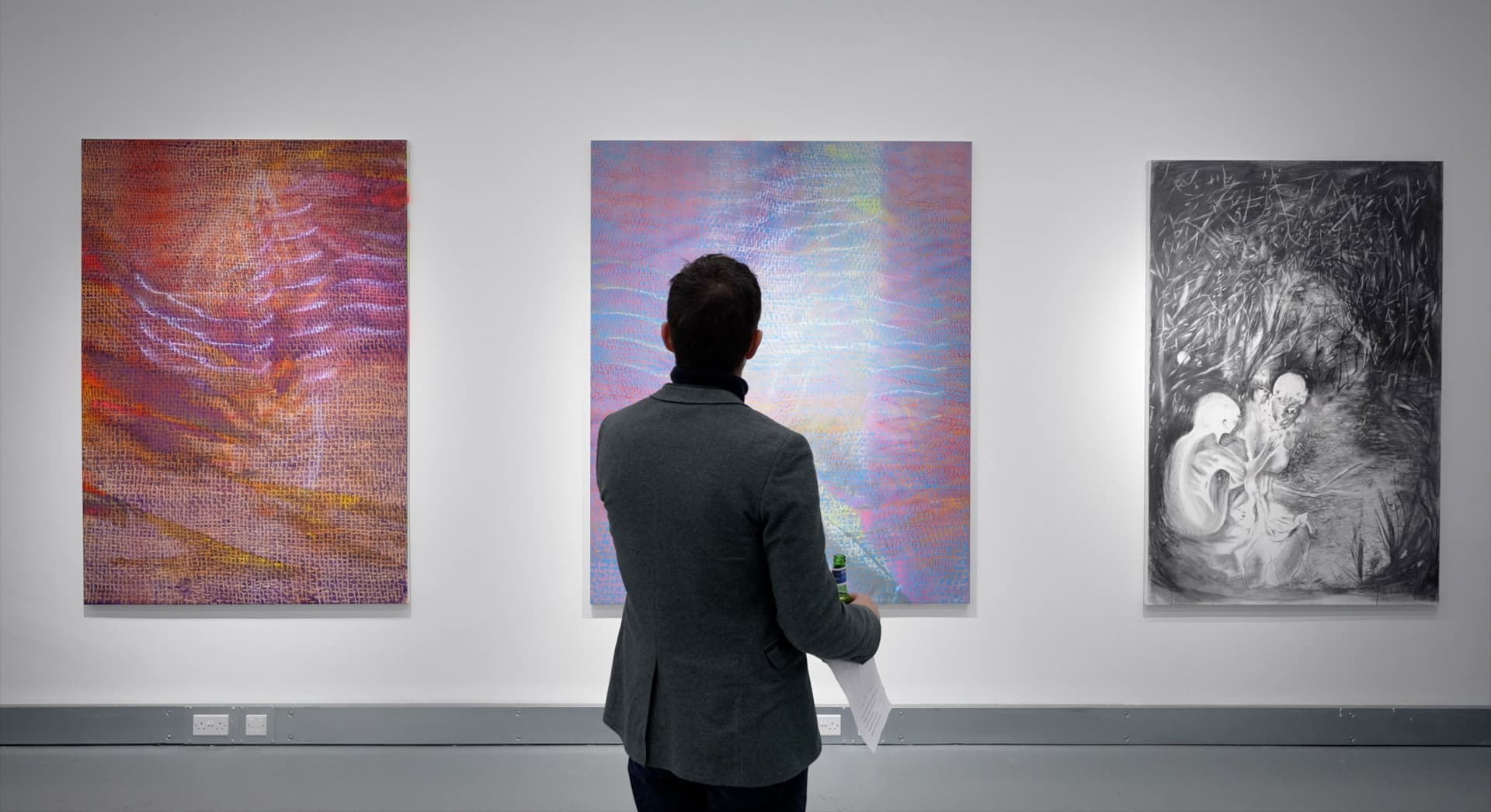
I’m also interested in how the introduction of objects and videos impacted your painterly practice, making it less figurative: it is as if by adding objects to your narrative, you felt liberated to depart from representation in your canvases.
SA-A
While these works are still figurative, I was approaching them in a different way. I wanted them to expand into fragmentation and my process of collecting.
Earlier this year, I began grouping my image collection into a system I called ‘taxonomy of touch’ into a map on my studio wall. Instead of thinking of the images in terms of subject, I classified them under different forms of touch, between subjects (human/non-human/non-living/object) and how this touch examined power dynamics between the subjects.
I think of this series of paintings as an extension of this, and how images relate to each other and the narratives that viewers would then impose on them.
I wanted the paintings to have the degraded quality that the videos have, for them to exist in that same world. There are subtle echoes to the digital and the way images sit in the digital – I used a lot of dry brushing, a slower process than my usual fluid and wet use of acrylics and ink. I enjoyed playing around with texture and manipulating the paint to do different things. This is why I enjoy acrylics the most, its ability to mimic different mediums.
I’m interested in building a world around COBRA, but I wanted that world to be constructed through a vague narrative, one that would be left to the viewer to reveal themselves through.